
The UK's "Sovereign AI R&D Procurement Scheme" -- anything but compliant procurement?

The UK Government has launched a ‘£100 million fund competition [to] help promising British AI start-ups start in the UK and tackle some of society's biggest challenges.’ The main purpose is to provide funding for UK-based start-ups to develop solutions tested in UK public services—initially across four priority areas inclusive of an ‘NHS productivity challenge’ seeking to boost AI development for the healthcare system.

In that stream, the funded start-ups will have access to ‘working with the Department of Health and Social Care to develop AI systems that can automate workflows, coordinate care and support decision-making across health services, helping deliver the ambitions of the NHS 10 Year Health Plan while improving productivity and staff experience’. Crucially, ‘successful firms will work with government departments to develop demonstrator-stage technologies with the potential to scale across the public sector and beyond’, while ‘keep[ing] the intellectual property they create, allowing them to take those innovations beyond the pilot stage and develop commercial products for customers in the UK and around the world’.

While this very much looks like a subsidy mechanism, it has been launched as a ‘procurement’ scheme. In this post, I take a closer look at a procurement scheme that seems to be about ‘anything but procurement’ and that, in my view, raises significant compliance risks.

The scheme as ‘exempted procurement’

As mentioned above, one of the interesting aspects of this initiative is that SOV/AI explicitly stresses that ‘[t]he scheme has been deliberately designed to help innovative start-ups to participate in public procurement, removing the barriers typically faced.’ It is unclear whether this statement refers to access to the scheme itself, or to access to procurement initiatives post-scheme. Either way, it is worth taking a closer look at the procurement implications of the scheme’s design.

The first observation is that the scheme is structured around the R&D services exemption in the Procurement Act 2023 (which is equivalent to the R&D exemption in eg Directive 2014/24/EU, art 14). The scheme’s competition guidance is explicit on this:
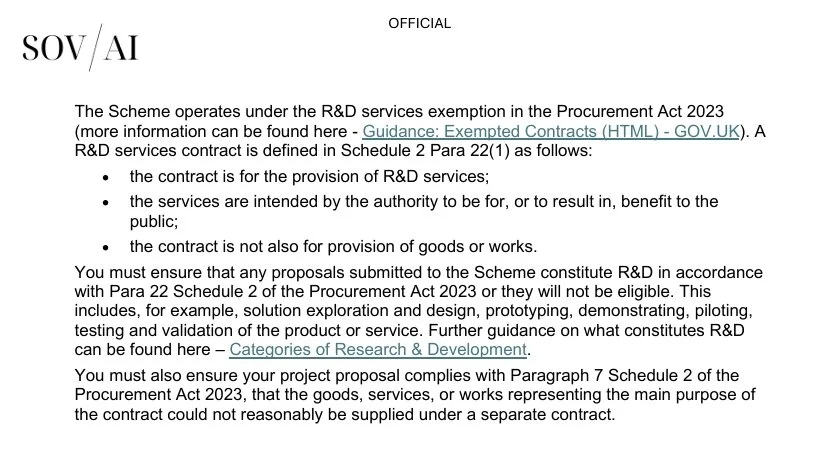
It is worth stressing that contracts for R&D services are included in the list of ‘subject-matter exempted contracts’ in Schedule 2 of the Procurement Act 2023. As the cited Guidance on Exempted Contracts makes clear, ‘[a]n exempted contract is a type of contract … to which the rules on covered procurement in the Procurement Act 2023 … do not apply.’ This sets aside most requirements in the Procurement Act 2023 (bar, mostly, some transparency requirements) and, in plain terms, makes the award of these contracts ‘not really procurement’. This creates significant procedural flexibility and SOV/AI has used it to reduce the qualitative selection requirements (or conditions for participation, in the Procurement Act’s terminology), in particular in relation to not setting minimum annual turnover, trading history, net assets, or cash reserves requirements—with other measures such as ‘prompt payment arrangements and simple contracting’ always being a possibility for covered procurement.

Precisely because the exemption places the award of R&D services (largely) outside the procurement rules, this requires narrow interpretation. In my view, the most difficult to meet constraint is that the R&D services must ‘be for, or result in, benefit to the public’. The Guidance on Exempted Contracts further elaborates on this requirement by stressing that ‘[t]he R&D services exemption gives contracting authorities the freedom to design R&D programs that could seek to develop products or technology for the benefit of the market as a whole, and for which the authority itself has no requirements’ (para 41, emphasis added). I have doubts that a scheme that ‘has been designed to help companies establish a direct supplier-customer relationship with public-sector organisations’, and where start-ups retain the relevant IP rights but the government obtains a seemingly unlimited licence, meets this constraint.

First, because IP retention by the developing start-up and government licencing raises a significant question on whether the R&D is ‘for the benefit of the market as a whole’, rather than the start-up and the government narrowly. Second, because it seems clear that the solutions are to be co-developed with DHSC (or other relevant departments in the parallel streams) and, consequently, it is hard to see how ‘the authority itself has no requirements’ for solutions meant to address specific challenges and meant to be operational in the specific context foreseen by the authority. This is particularly questionable in view of the FAQs in the competition guidance, which explicitly state the following:

Will the scheme give me direct access to the end users? The relevant challenge-owning department is expected to support each funded project, including by contributing relevant operational context and engaging with the supplier during delivery. The precise form and level of engagement will depend on the challenge.

In my view, this raises significant compliance risks in relation to the scheme in itself, as its terms seem to breach the constraints for the exemption on which it relies. Moreover, given its focus on ‘post-scheme’ commercialisation, there are additional compliance risks to consider.

Compliance risks for future acquisition/procurement

It seems clear that the scheme intends to create a ‘pathway to market’ for developers of AI solutions for the NHS (and other challenge-owning departments), at least where SOV/AI indicates that ‘[b]y becoming an early customer, government can help companies validate their technology in real-world settings and create a pathway to wider commercialisation.’ More specifically, the regulation of IP rights foresees that government is to be ‘granted a licence to use the outputs, data, and results for public sector purposes (this will be set out in the contract)’. This suggests a direct governmental acquisition of the solution and, on the face of it, this is not subject to any limitations in terms of volume of adoption or use under the licence.

I have several concerns on this specific issue.

First, because the Guidance on Exempted Contracts is clear that ‘[t]he scope of R&D services exemption is limited so it falls short of the commercial industrialisation of the goods and/or services’ (para 40) and, relatedly, that ‘Contracting authorities are also able to procure R&D under a competitive flexible procedure if, for example, the intention is to build an R&D phase into a procurement in order to be able to also purchase the resulting product’ (para 43, emphasis added). This creates a clear stop point preventing the government from becoming an early customer without running a separate procurement process—which could, of course, result in an award to another tech provider on the basis of a different solution.

This was been made (more) clear in recent comparable R&D competitions and, in particular, in the ProQure competition for Quantum Computing, which clearly indicated that:

  • ‘This competition is a standalone Contracts for Innovation competition. It does not involve the purchase of any solution, and taking part in this phase does not give any organisation automatic eligibility in any future procurement exercise’; and that

  • ‘Any adoption and implementation of a solution from this competition would be subject to a separate, possibly competitive, procurement exercise’ [the use of ‘possibly’ causing some discomfort here, though].

The Sovereign AI scheme is (at best) definitely less clear on this and, to the contrary, seems to suggest that the challenge-owning department (and potentially the entirety of government) will be adopting the developed solutions (for public sector purposes). In my view, any such outright acquisition or adoption of the solution without a separate procurement exercise would breach the limits of the R&D services exemption.

Beyond that, and second, I have doubts that a compliant workaround could be found to run a separate but not competitive procurement exercise. This would need to be justified on one of the grounds for direct award in Schedule 5 of the Procurement Act 2023 and, in particular, likely rest on IP rights exclusivity (Sch 5 para 5). In my view, this would also create compliance risks because the IP exclusivity would have arisen from the earlier questionable award of the R&D services contract in terms that create a benefit for the start-up (the IP rights) rather than the market as a whole and, ultimately, undermines the limits of the R&D exemption. Moreover, beyond such a logic of pre-empting the avoidance of competitive procurement, it is important to highlight that a direct award based on IP exclusivity can only be made after the contracting authority has excluded the existence of any reasonably alternative solutions. This seems an extremely unlikely scenario, given the many ways in which AI can be implemented to address any given technical challenge, especially once the organisational and functional embeddings of challenges such as ‘NHS productivity’ involve.

Final thoughts

It seems that the ‘Sovereign AI R&D Procurement Scheme’ seeks to bypass or minimise procurement constraints in the co-development and acquisition of AI solutions and, in my opinion, that it does so in a way that raises present and future compliance risks or, to put it more clearly, in a way that exceeds the limits of the R&D services exemption. It is hard to understand why this is the case and why the scheme is not structured and presented as a subsidy scheme pure and simple (which would, however, raise the issue of the future ‘non-competitive’ procurement of the solutions). It is also hard to understand why the R&D exemption has been the one used by the UK government, given that at least some of the AI challenges that deserve funding could arguably have better coverage under other potential exemptions in relation to national security or public interest.

A good excuse? Delaying the Procurement Act 2023 to make procurement mission-oriented

The UK has been in a long process of procurement law reform that was due to kick in on 28 October 2024, following a 6-month ‘go live’ notice for the Procurement Act 2023. Today, a 4-month delay has been announced and the new UK procurement rules will only enter into force on 24 February 2025 (barring any further delays).

This announcement follows speculation (on LinkedIn) that a delay was necessary because the digital platform underpinning the new system would not have been ready on time. However, the reasons given by Cabinet Office point in a different direction. In the statement, the UK Government has indicated that, under the Procurement Act 2023,

… the previous administration (the Conservative government) published a National Procurement Policy Statement [this one] to which contracting authorities will have to have regard. But this Statement does not meet the challenge of applying the full potential of public procurement to deliver value for money, economic growth, and social value. [The Government has] therefore taken the decision to begin the vital work of producing a new National Procurement Policy Statement that clearly sets out this Government’s priorities for public procurement in support of our missions.

It is crucial that the new regime in the Procurement Act goes live with a bold and ambitious Statement that drives delivery of the Government’s missions, and therefore, I am proposing a short delay to the commencement of the Act to February 2025 so this work can be completed.

To be honest, I do not find this justification very convincing — whether it is a curtain to cover problems with the digital platform or not. This is because the National Procurement Policy Statement (NPPS) is bound to play a very minor role in procurement practice, given the awkward position it has within the set of duties arising from the Procurement Act 2023—as I explore in detail here. Moreover, the NPPS is by design bound to change in the future (especially when there is a change of government), but future changes to the NPPS will not trigger the sort of pause that is being implemented now. And, finally, pushing back the entry into force of the Procurement Act 2023 and the associated NPPS leaves is in the current default, where the previous iteration of the NPPS (this one, also by a Conservative government—I know, confusing, so let’s call it the ‘old’ NPPS) is supposed to be guiding procurement decisions. So, stopping the entry into force of the new NPPS to leave the old NPPS is not precisely going to create any change in policy and practice between now and February 2025 (even assuming the NPPS has policy delivery potential).

For me, this move and delay is concerning because it shows how the incoming Government places excessive hopes on procurement, and the NPPS in particular, as a policy delivery tool. More than ever, this stresses the need to have a serious conversation about the limits of procurement law and the need for hard law in many areas (starting with tackling climate change and supporting a just environmental transition) if we are to unlock the change we need at the required pace.

Articulating the public interest in procurement law and policy

Earlier this year, I had some very interesting conversations with Bristol colleagues about the relationship between law, regulation, and the public interest. These conversations led to a series of blog posts that are being published in our Law School blog.

This prompted me to think a bit more in detail about how the public interest is articulated in public procurement law and policy. Eventually, I wrote a draft paper based on the review of procurement goals embedded in the UK’s new Procurement Act 2023, which will enter into force next month (on 28 October 2023).

I presented the paper at the SLS conference today (the slides are available here) and had some initial positive feedback. I would be interested in additional feedback before I submit it for peer review.

As always, comments warmly welcome: a.sanchez-graells@bristol.ac.uk. The abstract is as follows:

In this paper, I explore the notion of public interest embedded in the Procurement Act 2023. I use this new piece of legislation as a contemporary example of the difficulty in designing a 'public interest centred' system of public procurement regulation. I show how a mix of explicit, referential, and implicit public interest objectives results in a situation where there are multiple sources of objectives contracting authorities need to consider in their decision-making, but there is no prioritisation of sources or objectives. I also show that, despite this proliferation of sources and objectives and due to the unavailability of effective means of judicial challenge or administrative oversight, contracting authorities retain almost unlimited discretion to shape the public interest and 'what it looks like' in relation to the award of each public contract. I conclude with a reflection the need to reconsider the ways in which public procurement can foster the public interest, in light of its limitations as a regulatory tool.

Implementation Challenges for the Procurement Act 2023

I have put together a consolidated overview of the primary challenges for the implementation of the Procurement Act 2023, to be included as a country report in a forthcoming issue of the European Procurement & Public Private Partnership Law Review.

It brings together developments discussed in the blog over the last year or so, including the transparency ambition, the innovation ambition, and the training offer linked to the Transforming Public Procurement project.

In case of interest, it can be downloaded from SSRN: https://ssrn.com/abstract=4692660.

It contains nothing new, though, so assiduous readers may want to skip this one!

Innovation procurement under the Procurement Act 2023 -- changing procurement culture on the cheap?

On 13 November 2023, the UK Government published guidance setting out its ambitions for innovation procurement under the new Procurement Act 2023 (not yet in force, of which you can read a summary here). This further expands on the ambitions underpinning the Transforming Public Procurement project that started after Brexit. The Government’s expectation is that the ‘the new legislation will allow public procurement to be done in more flexible and innovative ways’, and that this will ‘enable public sector organisations to embrace innovation more’.

The innovation procurement guidance bases its expectation that the Procurement Act will unlock more procurement of innovation and more innovative procurement on the ambition that this will be an actively supported policy by all relevant policy- and decision-makers and that there will be advocacy for the development of commercial expertise. A first hurdle here is that unless such advocacy comes with the investment of significant funds in developing skills (and this relates to both commercial and technical skills, especially where the innovation relates to digital technologies), such high-level political buy-in may not translate into any meaningful changes. The guidance itself acknowledges that the ‘overall culture, expertise and incentive structure of the public sector has led to relatively low appetite for risk and experimentation’. Therefore, that greater investment in expertise needs to be coupled with a culture change. And we know this is a process that is very difficult to push forward.

The guidance also indicates that ‘Greater transparency of procurement data will make it easier to see what approaches have been successful and encourage use of those approaches more widely across the public sector.’ This potentially points to another hurdle in unlocking this policy because generic data is not enough to support innovation procurement or the procurement of innovation. Being able to successfully replicate innovation procurement practices requires a detailed understanding of how things were done, and how they need to be adapted when replicated. However, the new transparency regime does not necessarily guarantee that such granular and detailed information will be available, especially as the practical level of transparency that will stem from the new obligations crucially hinges on the treatment of commercially sensitive information (which is exempted from disclosure in s.94 PA 2023). Unless there is clear guidance on disclosure / withholding of sensitive commercial information, it can well be that the new regime does not generate additional meaningful (publicly accessible) data to push the knowledge stock and support innovative procurement. This is an important issue that may require further discussion in a separate post.

The guidance indicates that the changes in the Procurement Act will help public buyers in three ways:

  • The new rules focus more on delivering outcomes (as opposed to ‘going through the motions’ of a rigid process). Contracting authorities will be able to design their own process, tailored to the unique circumstances of the requirement and, most importantly, those who are best placed to deliver the best solution.

  • There will be clearer rules overall and more flexibility for procurers to use their commercial skills to achieve the desired outcomes.

  • Procurers will be able to better communicate their particular problem to suppliers and work with them to come up with potential solutions. Using product demonstrations alongside written tenders will help buyers get a proper appreciation of solutions being offered by suppliers. That is particularly impactful for newer, more innovative solutions which the authority may not be familiar with.

Although the guidance document indicates that the ‘new measures include general obligations, options for preliminary market engagement, and an important new mechanism, the Competitive Flexible Procedure’, in practice, there are limited changes to what was already allowed in terms of market consultation and the general obligations— to eg publish a pipeline notice (for contracting authorities with an annual spend over £100 million), or to ‘have regard to the fact that SMEs face barriers to participation and consider whether these barriers can be removed or reduced’—are also marginal (if at all) changes from the still current regime (see regs.48 and 46 PCR 2015). Therefore, it all boils down to the new ‘innovation-friendly procurement processes’ that are enabled by the flexible (under)regulation of the competitive flexible procedure (s.20 PA 2023).

The guidance stresses that the ‘objective is that the Competitive Flexible Procedure removes some of the existing barriers to procuring new and better solutions and gives contracting authorities freedom to enable them to achieve the best fit between the specific requirement and the best the market offers.’ The example provided in the guidance provides the skeleton structure of a 3-phase procedure involving an initial ideas and feasibility phase 1, an R&D and prototype phase 2 and a final tendering leading to the award of a production/service contract (phase 3). At this level of generality, there is little to distinguish this from a competitive dialogue under the current rules (reg.30 PCR 2015). Devil will be in the detail.

Moreover, as repeatedly highlighted from the initial consultations, the under-regulation of the competitive flexible procedure will raise the information costs and risks of engaging with innovation procurement as each new approach taken by a contracting authority will require significant investment of time in its design, as well as an unavoidable risk of challenge. The incentives are not particularly geared towards facilitating risk-taking. And any more detailed guidance on ‘how to'‘ carry out an innovative competitive flexible procedure will simply replace regulation and become a de facto standard through which contracting authorities may take the same ‘going through the motions’ approach as the process detailed in teh guidance rigidifies.

The guidance acknowledges this, at least partially, when it stresses that ‘Behavioural changes will make the biggest difference’. Such behavioural changes will be supported through training, which the guidance document also describes (and there is more detail here). The training offered will consist of:

  • Knowledge drops (open to everyone): An on-demand, watchable resource up to a maximum of 45 minutes in total, providing an overview of all of the changes in legislation.

  • E-learning (for skilled practitioners within the public sector only): a learning & development self-guided course consisting of ‘10 1-hour modules and concludes with a skilled practitioner certification’.

  • Advanced course deep dives (for public sector expert practitioners only): ‘3-day, interactive, instructor-led course. It consists of virtual ‘deep dive’ webinars, which allow learners to engage with subject matter experts. This level of interaction allows a deeper insight across the full spectrum of the legislative change and support ‘hearts and minds’ change amongst the learner population (creating ‘superusers’).

  • Communities of practice (for skilled and expert practitioners only): ‘a system of collective critical inquiry and reflection into the regime changes. Supported by the central team and superusers, they will support individuals to embed what they have learned.’

As an educator and based on my experience of training expert professionals in complex procurement, I am skeptical that this amount of training can lead to meaningful changes. The 45-minute resource can hardly cover the entirety of changes in the Procurement Act, and even the 10 hour course for public buyers only will be quite limited in how far it can go. 3 days of training are also insufficient to go much further than exploring a few examples in meaningful detail. And this is relevant because that training is not only for innovation procurement, but for all types of ‘different’ procurement under the Procurement Act 2023 (ie green, social, more robustly anti-corruption, more focused on contract performance, etc). Shifting culture and practice would require a lot more than this.

It is also unclear why this (minimal) investment in public sector understanding of the procurement framework has not taken place earlier. As I already said in the consultation, all of this could have taken place years ago and a better understanding of the current regime would have led to improvements in the practice of innovative procurement in the UK.

All in all, it seems that the aspirations of more innovation procurement and more innovative procurement are pinned on a rather limited amount of training and in (largely voluntary, in addition to the day job) collaboration for super-user experienced practitioners (who will probably see their scarce skills in high demand). It is unclear to me how this will be a game changer. Especially as most of this (and in particular collaboration and voluntary knowledge exchange) could already take place. It may be that more structure and coordination will bring better outcomes, but this would require adequate and sufficient resourcing.

Whether there will be more innovation procurement then depends on whether more money will be put into procurement structures and support. From where I stand, this is by no means a given. I guess we’ll have to wait and see.