
The UK Government has launched a ‘£100 million fund competition [to] help promising British AI start-ups start in the UK and tackle some of society's biggest challenges.’ The main purpose is to provide funding for UK-based start-ups to develop solutions tested in UK public services—initially across four priority areas inclusive of an ‘NHS productivity challenge’ seeking to boost AI development for the healthcare system.
In that stream, the funded start-ups will have access to ‘working with the Department of Health and Social Care to develop AI systems that can automate workflows, coordinate care and support decision-making across health services, helping deliver the ambitions of the NHS 10 Year Health Plan while improving productivity and staff experience’. Crucially, ‘successful firms will work with government departments to develop demonstrator-stage technologies with the potential to scale across the public sector and beyond’, while ‘keep[ing] the intellectual property they create, allowing them to take those innovations beyond the pilot stage and develop commercial products for customers in the UK and around the world’.
While this very much looks like a subsidy mechanism, it has been launched as a ‘procurement’ scheme. In this post, I take a closer look at a procurement scheme that seems to be about ‘anything but procurement’ and that, in my view, raises significant compliance risks.
The scheme as ‘exempted procurement’
As mentioned above, one of the interesting aspects of this initiative is that SOV/AI explicitly stresses that ‘[t]he scheme has been deliberately designed to help innovative start-ups to participate in public procurement, removing the barriers typically faced.’ It is unclear whether this statement refers to access to the scheme itself, or to access to procurement initiatives post-scheme. Either way, it is worth taking a closer look at the procurement implications of the scheme’s design.
The first observation is that the scheme is structured around the R&D services exemption in the Procurement Act 2023 (which is equivalent to the R&D exemption in eg Directive 2014/24/EU, art 14). The scheme’s competition guidance is explicit on this:
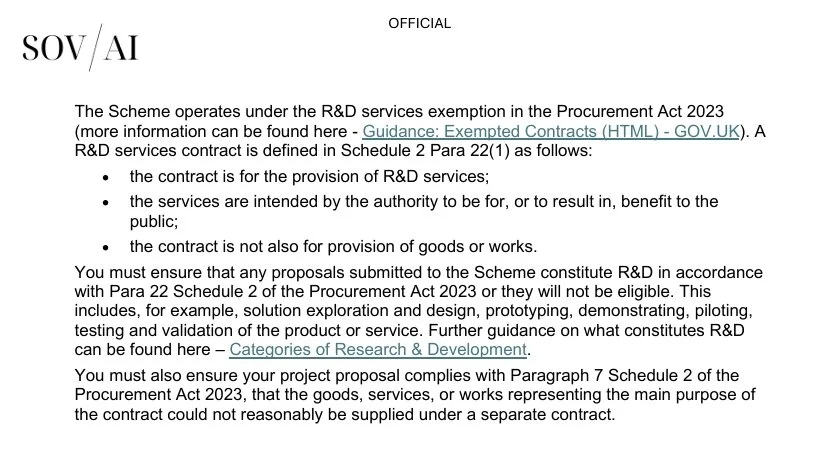
It is worth stressing that contracts for R&D services are included in the list of ‘subject-matter exempted contracts’ in Schedule 2 of the Procurement Act 2023. As the cited Guidance on Exempted Contracts makes clear, ‘[a]n exempted contract is a type of contract … to which the rules on covered procurement in the Procurement Act 2023 … do not apply.’ This sets aside most requirements in the Procurement Act 2023 (bar, mostly, some transparency requirements) and, in plain terms, makes the award of these contracts ‘not really procurement’. This creates significant procedural flexibility and SOV/AI has used it to reduce the qualitative selection requirements (or conditions for participation, in the Procurement Act’s terminology), in particular in relation to not setting minimum annual turnover, trading history, net assets, or cash reserves requirements—with other measures such as ‘prompt payment arrangements and simple contracting’ always being a possibility for covered procurement.
Precisely because the exemption places the award of R&D services (largely) outside the procurement rules, this requires narrow interpretation. In my view, the most difficult to meet constraint is that the R&D services must ‘be for, or result in, benefit to the public’. The Guidance on Exempted Contracts further elaborates on this requirement by stressing that ‘[t]he R&D services exemption gives contracting authorities the freedom to design R&D programs that could seek to develop products or technology for the benefit of the market as a whole, and for which the authority itself has no requirements’ (para 41, emphasis added). I have doubts that a scheme that ‘has been designed to help companies establish a direct supplier-customer relationship with public-sector organisations’, and where start-ups retain the relevant IP rights but the government obtains a seemingly unlimited licence, meets this constraint.
First, because IP retention by the developing start-up and government licencing raises a significant question on whether the R&D is ‘for the benefit of the market as a whole’, rather than the start-up and the government narrowly. Second, because it seems clear that the solutions are to be co-developed with DHSC (or other relevant departments in the parallel streams) and, consequently, it is hard to see how ‘the authority itself has no requirements’ for solutions meant to address specific challenges and meant to be operational in the specific context foreseen by the authority. This is particularly questionable in view of the FAQs in the competition guidance, which explicitly state the following:
Will the scheme give me direct access to the end users? The relevant challenge-owning department is expected to support each funded project, including by contributing relevant operational context and engaging with the supplier during delivery. The precise form and level of engagement will depend on the challenge.
In my view, this raises significant compliance risks in relation to the scheme in itself, as its terms seem to breach the constraints for the exemption on which it relies. Moreover, given its focus on ‘post-scheme’ commercialisation, there are additional compliance risks to consider.
Compliance risks for future acquisition/procurement
It seems clear that the scheme intends to create a ‘pathway to market’ for developers of AI solutions for the NHS (and other challenge-owning departments), at least where SOV/AI indicates that ‘[b]y becoming an early customer, government can help companies validate their technology in real-world settings and create a pathway to wider commercialisation.’ More specifically, the regulation of IP rights foresees that government is to be ‘granted a licence to use the outputs, data, and results for public sector purposes (this will be set out in the contract)’. This suggests a direct governmental acquisition of the solution and, on the face of it, this is not subject to any limitations in terms of volume of adoption or use under the licence.
I have several concerns on this specific issue.
First, because the Guidance on Exempted Contracts is clear that ‘[t]he scope of R&D services exemption is limited so it falls short of the commercial industrialisation of the goods and/or services’ (para 40) and, relatedly, that ‘Contracting authorities are also able to procure R&D under a competitive flexible procedure if, for example, the intention is to build an R&D phase into a procurement in order to be able to also purchase the resulting product’ (para 43, emphasis added). This creates a clear stop point preventing the government from becoming an early customer without running a separate procurement process—which could, of course, result in an award to another tech provider on the basis of a different solution.
This was been made (more) clear in recent comparable R&D competitions and, in particular, in the ProQure competition for Quantum Computing, which clearly indicated that:
‘This competition is a standalone Contracts for Innovation competition. It does not involve the purchase of any solution, and taking part in this phase does not give any organisation automatic eligibility in any future procurement exercise’; and that
‘Any adoption and implementation of a solution from this competition would be subject to a separate, possibly competitive, procurement exercise’ [the use of ‘possibly’ causing some discomfort here, though].
The Sovereign AI scheme is (at best) definitely less clear on this and, to the contrary, seems to suggest that the challenge-owning department (and potentially the entirety of government) will be adopting the developed solutions (for public sector purposes). In my view, any such outright acquisition or adoption of the solution without a separate procurement exercise would breach the limits of the R&D services exemption.
Beyond that, and second, I have doubts that a compliant workaround could be found to run a separate but not competitive procurement exercise. This would need to be justified on one of the grounds for direct award in Schedule 5 of the Procurement Act 2023 and, in particular, likely rest on IP rights exclusivity (Sch 5 para 5). In my view, this would also create compliance risks because the IP exclusivity would have arisen from the earlier questionable award of the R&D services contract in terms that create a benefit for the start-up (the IP rights) rather than the market as a whole and, ultimately, undermines the limits of the R&D exemption. Moreover, beyond such a logic of pre-empting the avoidance of competitive procurement, it is important to highlight that a direct award based on IP exclusivity can only be made after the contracting authority has excluded the existence of any reasonably alternative solutions. This seems an extremely unlikely scenario, given the many ways in which AI can be implemented to address any given technical challenge, especially once the organisational and functional embeddings of challenges such as ‘NHS productivity’ involve.
Final thoughts
It seems that the ‘Sovereign AI R&D Procurement Scheme’ seeks to bypass or minimise procurement constraints in the co-development and acquisition of AI solutions and, in my opinion, that it does so in a way that raises present and future compliance risks or, to put it more clearly, in a way that exceeds the limits of the R&D services exemption. It is hard to understand why this is the case and why the scheme is not structured and presented as a subsidy scheme pure and simple (which would, however, raise the issue of the future ‘non-competitive’ procurement of the solutions). It is also hard to understand why the R&D exemption has been the one used by the UK government, given that at least some of the AI challenges that deserve funding could arguably have better coverage under other potential exemptions in relation to national security or public interest.